Here are some interesting facts about the people and places along the Journey.
Aldie Mill – Built in Aldie, Virginia
from 1807-1809.
- Aldie Mill is one of the oldest gristmills still grinding grain in Virginia. It
was built during the presidency of Thomas Jefferson and features tandem water
wheels.
- During the Civil War, Aldie Mill supplied grain to soldiers and horses
for both the Confederate and Union armies.
- The "Gray Ghost of the Confederacy," John Singleton Mosby, surprised
Union Cavalrymen at Aldie Mill on March 2, 1863. Although the Union forces
outnumbered Mosby’s men by 3 to 1, some Union soldiers ran and hid in
the mill's flour bins when they saw Mosby coming. When captured, they
came out looking like snowmen.
AshLawn-Highland – Home
of President James Monroe. 
- Monticello, President Thomas Jefferson’s home, is visible across the mountain-top from his friend President James Monroe’s home at Ash Lawn-Highland. Both
homes are located in Albemarle County, Virginia near the city of Charlottesville.
- President James Monroe always called his property Highland. After
Monroe's death, a new owner changed the name of the farm to Ash Lawn. Today
both names are used.
- During the Revolutionary War, Monroe served in the Third Virginia Regiment
of the Continental Army. Emanuel Leutze’s famous painting, “Washington Crossing the Delaware,” depicts Monroe standing directly behind George Washington holding the American flag. Actually,
Monroe and a small group of volunteers had crossed the river before Washington
and the others and thus he was not in the same boat with Washington.
- Presidents Thomas Jefferson and John Adams died on the same day, July 4,
1826. James Monroe also died on July 4th, five years later. Thus 3 of the first 5 U.S. Presidents died on America’s “birthday,” the
Fourth of July.
Culpeper Museum and the Burgandine House – Located
in Culpeper, Virginia. The museum houses artifacts, photos, and memorabilia
from historic Culpeper County. 
- The Burgandine House is Culpeper’s oldest house, and was known to
be standing in 1749 when Culpeper County was created.
- The Burgandine House was used as a tavern during the Revolutionary War.
- George Washington was the official Culpeper County surveyor from 1749-1751. He
was 17 years old.
- The Battle of Brandy Station, June 9, 1863 and fought in Culpeper County,
was the largest cavalry battle ever fought in North America.
- Clara Barton, founder of the American Red Cross, performed her first field
duty at the Battle of Cedar Mountain in August of 1862 in Culpeper County.
- There are 215 million year old dinosaur tracks in Culpeper County. They
are the largest number of tracks found at any single site in the world.
Dodona Manor – Home of General
George Marshall 
- When Mrs. Marshall saw Dodona Manor and wanted to purchase it, her "earnest
money" was only $10! The beautiful house with it's almost 4 acres only
cost $ 16,000 total. The "For Sale" sign that Mrs. Marshall saw
in the yard is still at the house today.
- The Marshall’s owned a painting that was painted by Winston Churchill
and given to the General Marshall in 1953. When Katherine Marshall's
granddaughter sold it recently, it brought 1.2 million dollars, the most
ever paid for a Churchill painting. There is a digital photograph of it in
the living room of Dodona Manor today.
- Dodona Manor was a girl's school during the Civil War.
- When the Marshall’s purchased Dodona Manor in 1941, there were only
1700 people living in Leesburg. The town had only 1 traffic light and 1 doctor.
Eisenhower Home and Farm – Home
of President and Mrs. Dwight D. Eisenhower. 
- The First Lady Mamie Eisenhower’s guest book still sits open on a table
in the entrance hall of the Eisenhower home. Everyone who came to the
door would sign in, from world leaders like Winston Churchill to the four Eisenhower
grandchildren who lived a half block down the road. The grandchildren
would try to sneak in the back door to avoid having to sign the guest book
at every visit.
- The President raised Black Angus cattle on his farm. Forty to fifty
head of Angus graze on the farm today.
- Eight to ten Secret Service agents were stationed at the farm whenever
the President was in residence. The agents turned the barn’s
milk house into their office and concealed closed circuit TV cameras and
electric eye beams throughout the grounds.
- President Eisenhower buried a time capsule on the grounds of his farm at
Gettysburg.
Exchange Hotel – Located
in Gordonsville, Virginia. 
- The hotel was built in 1860 as a luxury stopover for weary travelers on the
Virginia Central Railway.
- In 1862, the Confederate Army transformed the Exchange Hotel into the Gordonsville
Receiving Hospital. Soldiers from nearby battlefields were brought
there by the train loads.
- The Gordonsville Receiving Hospital treated both Confederate and Union
soldiers. The
death rate was less than 1% of the over 70,000 men who were given medical care there.
- During Reconstruction, the hospital served newly freed slaves as a freedman's
bureau hospital.
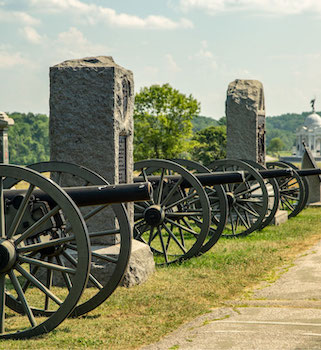
Gettysburg Battlefield: - Site of the
Civil War battle in Adams County, Pennsylvania fought from July 1-3, 1863. 
- The battle of Gettysburg was the Civil War’s bloodiest, with 51,000
men killed.
- The Gettysburg battle is considered the turning point of the Civil War. Badly
defeated, Confederate General Robert E. Lee and his troops retreated to Virginia
never again to invade northern soil.
- Seeking a proper burial ground for the Union troops who died in the battle,
a portion of the battlefield was purchased and designated the “Soldiers’ National
Cemetery.” However, removal of the dead bodies to the cemetery
took was a difficult task that was not completed until well after the cemetery’s
dedication on November 19, 1863 when President Abraham Lincoln delivered
his Gettysburg Address.
- The Gettysburg National Military Park encompasses 5,989 acres of land.
Harpers Ferry – Harpers Ferry,
located at the junction of the Potomac and Shenandoah Rivers in West Virginia,
is the site of a famous raid on its arsenal by fanatic John Brown. This
raid is considered an important precursor to the Civil War. 
- John Brown had two wives who bore him 20 children.
- The wife of a Secret Six member, the secret supporters of John Brown’s
raid, wrote the Battle Hymn of the Republic.
- The great-grandnephew of George Washington was captured by John Brown’s
men and held hostage by his own slaves during the raid on Harpers Ferry.
- The United States Army set fire to the small arsenal building when Virginia
seceded from the Union. The fire caused an explosion which burned and
prevented roughly 15,000 rifles from falling into Confederate hands.
Manassas Battlefield – Site
of two major battles of the Civil War. 
- There were actually two battles fought at Manassas. The First Battle
of Manassas in 1861 was the first major land battle of the Civil War. The
Second Battle of Manassas was fought in 1862.
- During the war, the North generally named a battle after the closest river,
stream or creek and the South tended to name battles after towns or railroad
junctions. Hence the Confederate name Manassas after Manassas Junction and
the Union name Bull Run for the stream Bull Run.
- The First Battle of Manassas convinced President Lincoln that the war would
be long and costly.
- The Second Battle of Manassas brought the Confederacy to the height of
its power.
- Thomas Jonathan Jackson earned the nickname, “Stonewall,” at
the First Battle of Manassas.
Manassas Museum – Dedicated
to celebrating the history and culture of Manassas, Virginia. 
- The Manassas Museum occupies the land that once housed Swavely Academy, a
college preparatory school.
- The Liberia Plantation house is owned by the museum. Built in 1825,
it served as the headquarters for Confederate General P.G.T. Beauregard in
1861 and for Union General Irvin McDowell in 1862. Liberia contains
examples of recently uncovered Civil War graffiti left by Union soldiers
in August, 1862.
- Another museum property, the Hopkins Candy Factory was built in 1908 in
downtown Manassas. The Hopkins Candy Factory once shipped its candies
to merchants in every state east of the Mississippi River.
Montpelier – Home
of James Madison, the fourth U. S. President. 
- James Madison was a short man, standing somewhere between 5'4" and 5'6".
- Dolley Madison, President Madison’s outgoing wife, was the first
woman to serve ice cream at the White House.
- James and Dolley Madison had a pet macaw named "Polly" that liked
to chase children.
- James Madison's nickname was the "Father of the Constitution" because
he is credited with being the principal author of the Constitution of the
United States.
Monticello – Home of President Thomas Jefferson. It
is located in Albemarle, Virginia. 
- Thomas Jefferson had no middle name and played the violin.
- Thomas Jefferson organized races for his grandchildren outside on the West
Lawn of
- Monticello. The winner received dried fruit as a prize.
- Monticello has 33 rooms on four floors and took more than 40 years to build.
- John Hemmings was a talented enslaved joiner who lived at Monticello. We
know he helped build parts of Monticello, including an archway in Jefferson's
library.
Morven Park – Historic home
located in Loudoun County, Virginia near the Potomac River and the border
with the state of Maryland. 
- Two governors have owned and lived at Virginia's Morven Park. They
are Thomas Swann, Jr. from Maryland (governor during 1866-1869) and Westmoreland
Davis from Virginia (governor during 1918-1922.)
- Both Confederate and Union soldiers used Morven Park as an encampment site
and a parade ground during the Civil War, but not at the same time. Units
from Virginia, South Carolina, Mississippi, Pennsylvania, and Maine camped
there.
- Morven Park today is the largest green space in the town of Leesburg, Virginia.
Mosby, Rector House, Rector's Crossroads, and the offices of the Mosby
Heritage Area – The Mosby Heritage Area celebrates the geographic
area where John Singleton Mosby, a Confederate Cavalry Officer during the
Civil War, was known for his ability to evade capture. 
- The name, “Mosby Heritage Area” is derived from the rich oral
history about local legend John Singleton Mosby, the "Gray Ghost of
the Confederacy,"
- Most people familiar with his “larger than life” reputation, are
surprised to hear that Mosby weighed only 125 pounds and stood 5'7" tall. It
is said that it was his eyes, not his size that commanded people's attention.
- Confederate General J.E.B. Stuart stayed in the yard of the Caleb Rector
House in Atoka, Virginia (known as Rector's Crossroads during the Civil War)
the night he received his orders from General Robert E. Lee on how the proceed
to Gettysburg. Stuart misinterpreted the orders and arrived late to Gettysburg,
much to Lee’s unhappiness.
Oatlands – Lovely
plantation in Loudoun County, Virginia built in the early nineteenth century
by George Carter. 
- Oatlands Plantation is one of the most photographed homes in Virginia. It
appears on many, many calendars and on a U.S. postage stamp.
- During the Civil War, Union prisoners taken at the Battle of Ball's Bluff
encamped in the rain on the grounds of Oatlands late the night after the
battle on October 21, 1861. The exhausted Yankees were only allowed to sleep
a few hours before marching on to Manassas Junction to catch the train to
go to prison in Richmond, Virginia.
- George Carter’s wife Elizabeth worked hard to save Oatlands after the
Civil War, even using her home in the 1880’s for what today might be
called a "bed and breakfast.” In the end, it was the steep
rise in county property taxes after the Civil War that forced an aging Mrs.
Carter to sell Oatlands in 1888. The taxes were used to build public schools
like the Mountain Gap one-room school house that still stands on the property
today.
- The Eustis family bought Oatlands in 1903. Mrs. Eustis was the daughter
of a Vice-President of the United States, Levi Parsons Morton.
Wilderness Battlefield – One of four Civil War battlefields
located in close proximity to each other near the town of Fredericksburg, Virginia. The
other battlefields are Fredericksburg, Spotsylvania, and Chancellorsville. 
- General Lee and General Grant faced each other for the first time in the Battle of the Wilderness, May 1864.
- General Ambrose Burnside, commanding the Northern Army of the Potomac at
the Battle of Fredericksburg, was easily recognized by his bushy cheek whiskers. Today,
we call these whiskers sideburns.
- Both the poet Walt Whitman and Clara Barton, founder of the American Red
Cross, cared for the wounded following the Battle of Fredericksburg.
- Stonewall Jackson's daring flank attack at Battle of Chancellorsville on
May 2, 1862, is considered one of the most amazing battlefield achievements
in American military history.
|